25 September 2026
The market for publishing tools: what publishers are actually buying in 2026
Publishers say AI and data are their top investments, search traffic is falling, and a growing share of revenue comes from activities their systems were never built for. The industry's own surveys describe a market that is moving from plug-ins to platforms.
Three pillars instead of two
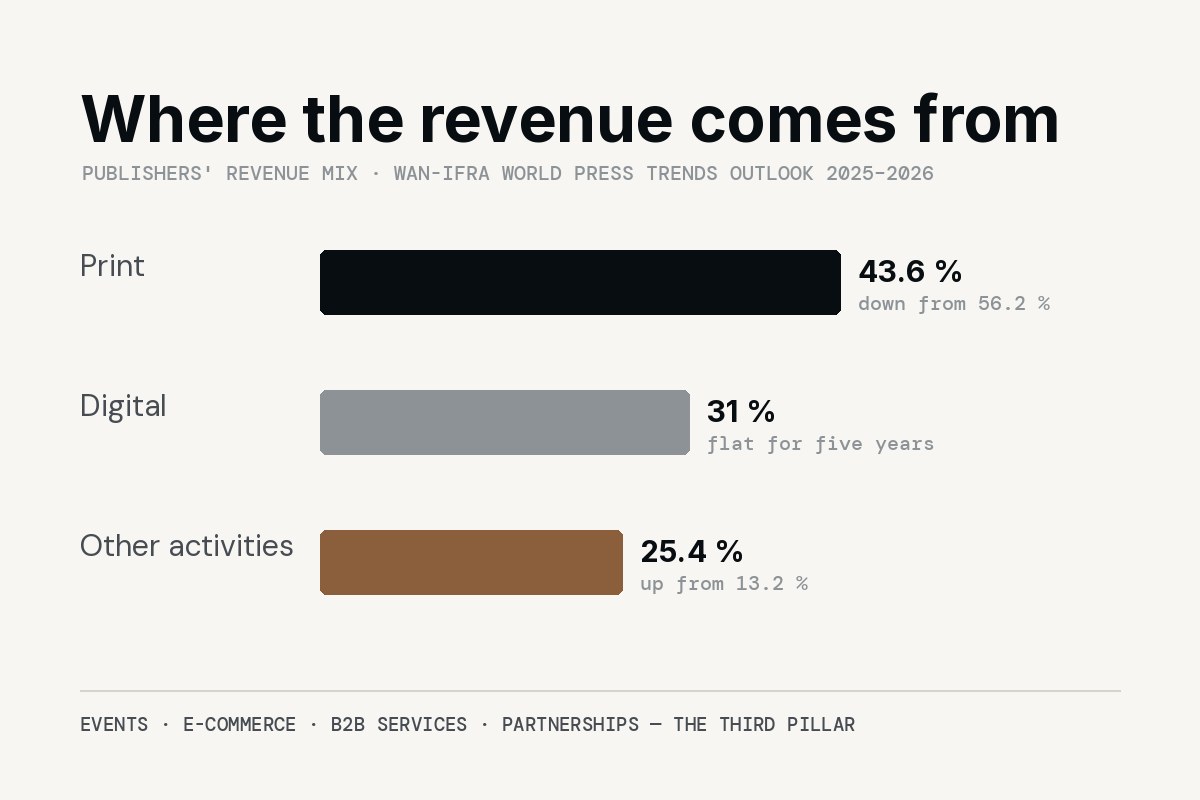
For two decades the publishing business was described as two columns – print and digital – with the second slowly replacing the first. The World Press Trends Outlook 2025–2026, published by WAN-IFRA in January 2026 from a survey of more than 170 senior executives in 66 countries, describes something else. Print still accounts for 43.6 percent of revenue, down from 56.2 percent five years earlier. Digital circulation and advertising has been stuck at around 31 percent for five years. The growth is in a third pillar – 'other activities' such as events, B2B services, e-commerce and platform partnerships – which has risen from 13.2 percent of revenue in 2021 to 25.4 percent.
That third pillar is where publishing tools have historically been weakest. A content management system stores articles; it does not run an affiliate programme, attribute a commission to the story that earned it, sell a partner page or measure an event. So the fastest-growing part of the business has been run in spreadsheets and separate services – which is exactly the fragmentation publishers now say they want to end.
What they say they will buy
Asked where they will invest, 93 percent of the executives in the WAN-IFRA survey named AI and automation as a priority, and 90 percent named data analytics and intelligence. Yet only 30.7 percent described their own AI adoption as sophisticated or advanced; 46.2 percent called it nascent. The gap between ambition and capability is the market.
The Reuters Institute's Journalism, Media and Technology Trends and Predictions 2026, based on 280 media leaders in 51 countries, points the same way. Ninety-seven percent consider back-end automation important, 82 percent prioritise AI in newsgathering and 81 percent in coding and product development. On the revenue side, subscriptions and membership remain the top priority (76 percent), followed by display advertising (68 percent), native advertising (64 percent) and events (54 percent). Only 20 percent expect significant revenue from licensing content to AI companies.
The traffic that is going away
The urgency comes from the top of the funnel. Publishers in the Reuters survey expect search referrals to fall by 43 percent over the next three years; Chartbeat data cited in the same report shows organic search traffic to news sites already down 33 percent globally between November 2024 and November 2025, as AI answers replace clicks. Advertisers are following the traffic: Forrester expects brands to cut open-web display spending by around 30 percent in 2026, and some agencies reported cuts of 20–30 percent during 2025.
Only 38 percent of media leaders told the Reuters Institute they were confident about journalism's prospects for 2026 – 22 points lower than in 2022 – although 53 percent remained confident about their own business. The difference between the two numbers is usually the business model: those with a returning audience, several revenue streams and their own data are the ones who feel in control.
The tools most publishers actually run
Against this backdrop, the tool most small and medium-sized publishers actually run is a general-purpose website system. WordPress powers 40.7 percent of all websites and holds 58.9 percent of the content management market, according to W3Techs (September 2026), with more than 71 000 free plug-ins available to extend it. It is an extraordinary achievement – and, for a media company, an incomplete one: translation, SEO, shopping links, analytics, newsletters and revenue reporting each arrive as a separate plug-in or service, with separate logins and no shared view of the reader or the euro.
| What publishers report | Figure | Source |
|---|---|---|
| Revenue from 'other activities' (events, e-commerce, B2B) | 25.4 % (2025), up from 13.2 % (2021) | WAN-IFRA World Press Trends Outlook 2025–26 |
| Print share of revenue | 43.6 %, down from 56.2 % | WAN-IFRA |
| AI and automation an investment priority | 93 % | WAN-IFRA |
| Back-end automation considered important | 97 % | Reuters Institute, Trends and Predictions 2026 |
| Expected fall in search referrals over three years | −43 % | Reuters Institute |
| Confidence in journalism's prospects | 38 % (2026) vs 60 % (2022) | Reuters Institute |
| Websites running WordPress | 40.7 % of all sites · 58.9 % of CMS | W3Techs, September 2026 |
From plug-ins to platforms
Put the surveys together and the buying pattern is clear. Publishers want automation they can trust, data they can act on, and revenue they can attribute – across print, digital and everything in the third pillar. They want it without an IT department, because most of them do not have one. And they want it to work with what they already run, because nobody can afford a big-bang migration in a year when the traffic is falling. The winners in the publishing-tools market will be the platforms that treat the whole business – newsroom, archive, audience, revenue and the AI colleagues working in between – as one system rather than a pile of extensions.