25 September 2026
How many media companies are there in Europe – and why most of them are small
Europe's publishing landscape is not a handful of large houses. It is tens of thousands of small and medium-sized companies, each with an archive, an audience and a brand of its own. Here is what the official numbers say about its size, its people and the money around it.
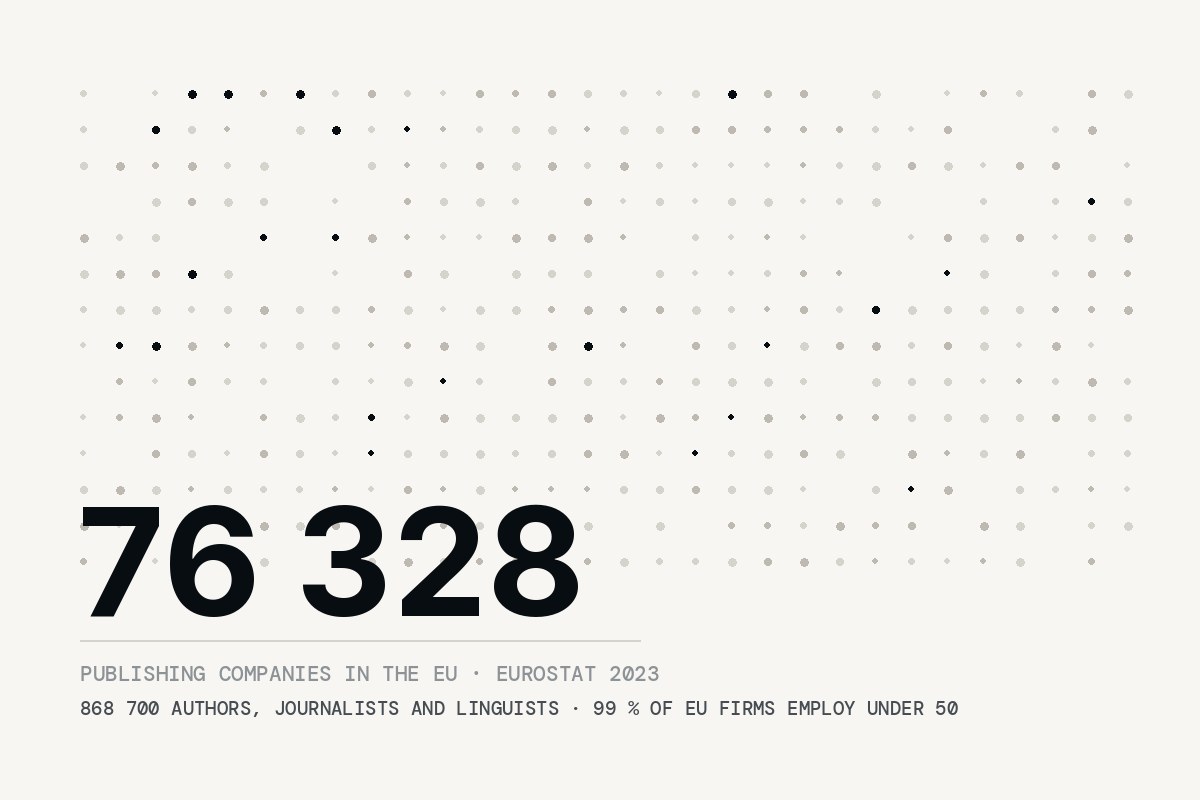
76 000 publishing companies
In 2023 there were 76 328 enterprises in the books and periodicals publishing industry in the European Union, according to Eurostat's structural business statistics. That figure covers the companies whose main activity is publishing newspapers, magazines, journals and books – the core of what most people mean by a media company – and leaves out broadcasters, pure digital-only start-ups classified elsewhere and the many publishing arms of organisations whose main business is something else. The real number of titles is higher still, because one company often publishes several.
The distribution across countries is uneven. France alone counts 23 648 publishing enterprises, followed by Spain (5 910), Germany (5 374), Czechia (5 349) and Italy (4 393). The difference between France and Germany is partly one of structure – France registers many very small publishers as separate companies – but it also shows how local the industry is: publishing is done in the language and for the market it serves.
Almost 870 000 people who write for a living
Behind the companies stand the people. Eurostat counted 868 700 people employed as authors, journalists or linguists in the EU in 2023, down 2.5 percent from 2022. Germany accounts for the largest share (237 600), ahead of France (92 800), Spain (74 200), Italy (72 300) and Poland (69 600). An earlier Eurostat count put employment in publishing activities as a whole at almost 789 000 people, or 0.4 percent of all EU employment, with Sweden, Finland, Denmark and Germany showing the highest shares.
An industry of small companies
What the numbers make plain is that European publishing is overwhelmingly a small-company business. Across the whole EU business economy, 99.0 percent of enterprises employ fewer than 50 people; only 0.2 percent – about 55 000 companies – are large. Publishing follows the same pattern: a few well-known groups, and behind them tens of thousands of houses with a handful of titles, a newsroom of five to fifty people, and no IT department to speak of.
Those companies own more than their articles. Each one holds an archive built up over years, an audience that returns out of habit, editorial expertise in a subject or a region, commercial relationships with brands and networks, data about what its readers actually do, and a brand people recognise. In most of them, only the first of these assets is systematically managed – it sits in a content management system – while the rest are handled by hand, by habit or not at all.
The money around them
The advertising market the industry competes in is large and growing. Digital advertising in Europe reached 131 billion euro in 2025, up 10.5 percent on the year, across the 30 national markets that IAB Europe measures. But the growth is concentrated where publishers are not: social advertising (35.5 billion euro, up 19.2 percent), video (34.0 billion, up 19.6 percent) and retail media (13.3 billion, up 16.7 percent) grew fastest, while paid search grew 8.8 percent. For a publisher, the lesson is that display alone will not carry the business – which is why the industry's own surveys now show a growing share of revenue coming from other sources: e-commerce and affiliate, events, B2B services and partnerships.
| Figure | Value | Source |
|---|---|---|
| Publishing enterprises (books and periodicals), EU | 76 328 (2023) | Eurostat |
| Largest markets by number of publishers | France 23 648 · Spain 5 910 · Germany 5 374 · Czechia 5 349 · Italy 4 393 | Eurostat, 2023 |
| Authors, journalists and linguists employed, EU | 868 700 (2023, −2.5 % vs 2022) | Eurostat |
| Share of EU enterprises with fewer than 50 employees | 99.0 % (2024) | Eurostat |
| Digital advertising, Europe (30 markets) | €131 bn (2025, +10.5 %) | IAB Europe AdEx Benchmark 2025 |
Why it matters
A market of 76 000 small companies has different needs from a market of ten large ones. It cannot afford custom-built systems, integration projects that take a year, or a vendor that only a specialist can operate. It needs publishing technology that is complete on day one, that treats every asset a publisher owns as something that can earn, and that a small team can run without an IT department. That is the market VOR is built for – and the reason we describe our customers as small and medium-sized media companies rather than as 'publishers' in the abstract.